The Rada Trust programs score IRS Form 990s to identify promising non-profits. What is the 990?
Form 990 (officially, the "Return of Organization Exempt From Income Tax") is a United States Internal Revenue Service (IRS) form that provides the public with information about a nonprofit organization.
Filing Requirement
Form 990 is due annually after the organization's fiscal year ends. A nonprofit organization that does not file annual returns for three consecutive years will have its tax-exempt status revoked.
A tax-exempt organization with annual gross receipts of less than $200,000 and assets less than $500,000 has the option of filing a shorter alternative form, Form 990-EZ instead.
Churches and their affiliates are not required to file.
Access
Public Inspection IRC 6104(d) regulations state that an organization must provide copies of its three most recent Forms 990 to anyone who requests them, whether in person, by mail, fax, or e-mail.
The IRS Tax Exempt Organization Search page offers summary information about nonprofits, as well as copies of their tax returns.
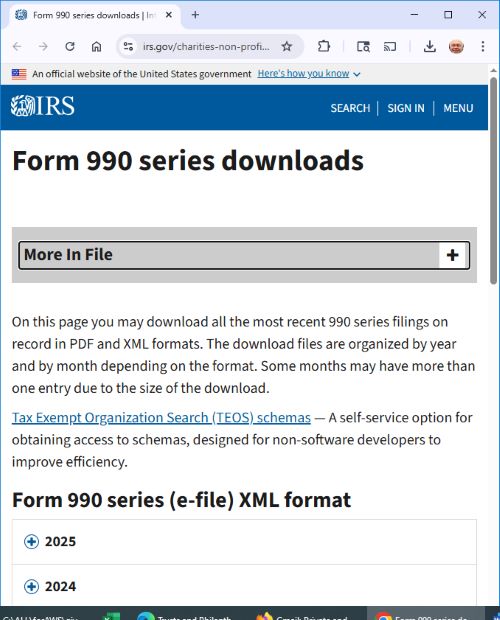
IRS website that offers all filed Form 990s.
From the 990, Rada extracts attributes specified in an input parameter file. The default parameter file specifies
30 attributes. The program stores one row per non-pronfit (501c3) and 30 columns for the 30 attribute values. For the year 2024 this leads to 360,000 rows (the IRS has more 990s, but the program excludes some filings, such as 990-EZ).
Those attributes include these which are shown as data type (such as string or integer) followed by the number of characters in that data type followed by the xml path to the attribute value in the Form 990 xml representation: